
There are exactly two worlds here: YouTube's official offline feature, and third-party tools. This guide covers both honestly — what the official option costs and where it falls short, which tools actually work in 2026, and what the rules really say. We build a downloader ourselves, and we'll be upfront about when you don't need it.
The quick answer
The official way: YouTube Premium's offline mode
YouTube's own download button is the only method the platform officially supports, and for pure offline watching it's genuinely good: tap Download under a video, and it's saved inside the YouTube app.
- Price: Premium is about $14/month in the US and ¥1,280/month in Japan (individual plan; prices vary by country). The cheaper Premium Lite tier (~¥780/month in Japan) also gained offline and background playback in early 2026.
- How it works: downloads are stored inside the app, playable for up to 29 days between re-connections — perfect for trips.
- The catch: you never get an actual file. No MP4 on your disk, nothing you can edit, archive, or move to another device. Downloads expire with your subscription.
If your goal is watching on a plane, stop reading here — Premium is the right answer, and it's the only one YouTube's terms bless.
What the rules actually say
Honesty section. YouTube's Terms of Service say you may not download content “unless specifically permitted by the Service” (that means the Premium button) or without written permission from YouTube or the rights holder. So third-party downloading of someone else's content is a ToS violation even when it isn't a copyright crime.
Copyright law is a separate layer and varies by country. As a rule of thumb: downloading your own uploads, Creative Commons videos, and content whose owner explicitly allows saving is generally fine; downloading copyrighted work without permission may be illegal (in Japan, knowingly downloading infringing uploads is explicitly unlawful). We're not lawyers — treat this as orientation, not legal advice.
Everything below is written for the legitimate cases: backing up your own channel, saving your podcast masters, archiving CC-licensed material, grabbing footage you have permission to use.
Getting an actual file: the honest tool guide
For legitimate downloads where you need a real MP4/MP3 file, these are the categories that exist in 2026 and how they actually perform:
| Tool | Type | Best for | Watch out for | Price |
|---|---|---|---|---|
| yt-dlp | Command line | The gold standard — best quality (4K/8K), playlists, subtitles, chapters; updated within days of every YouTube change | Terminal only; you'll type commands | Free |
| 4K Video Downloader Plus | Desktop app | Well-known GUI, handles YouTube well including playlists | Free tier limited; old “lifetime” licenses reportedly required re-purchase for Plus | $15/yr · $25 one-time |
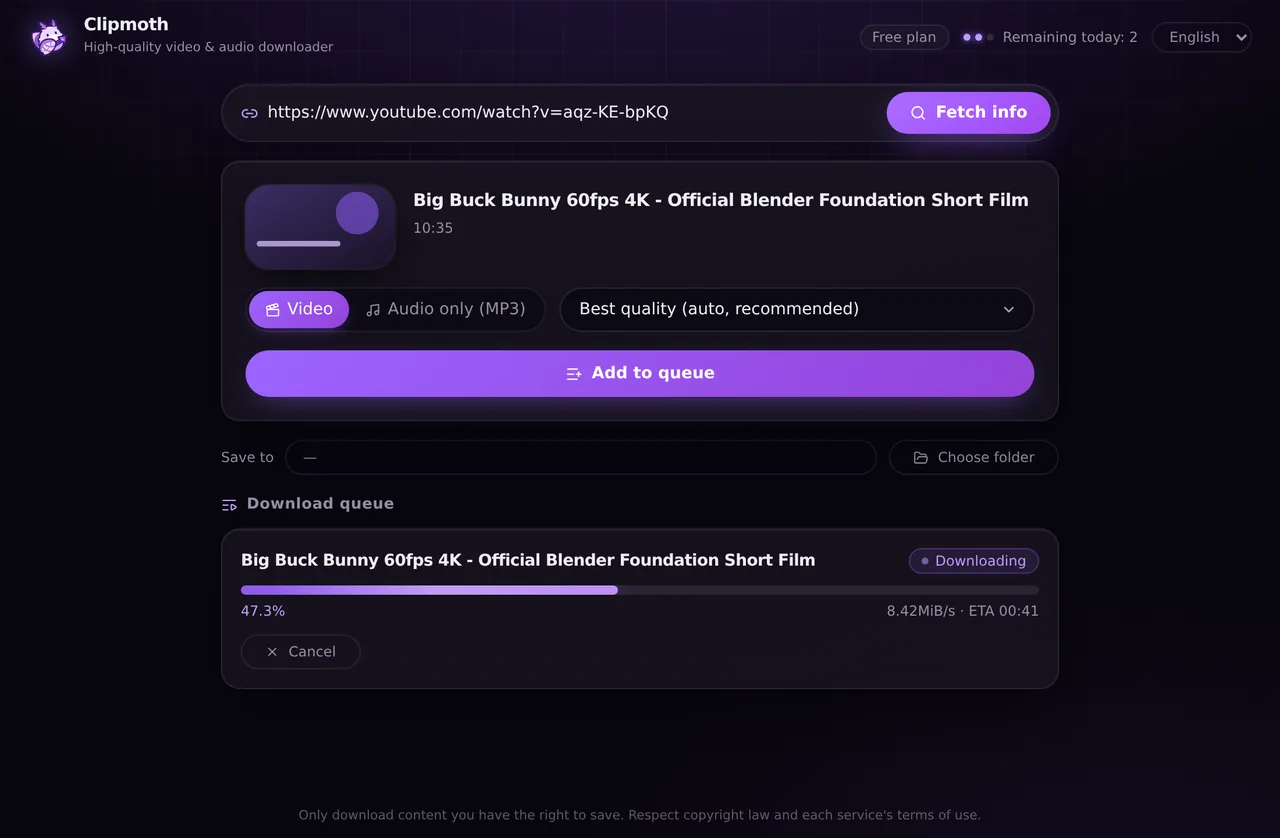
| Clipmoth — our tool | Desktop app (Windows) | yt-dlp's reliability with a simple queue UI; 4K, playlists, MP3 | Windows only for now; we make it, so we're biased | Free 3/day · $9.99 lifetime |
| Video DownloadHelper | Browser extension | General web video from ordinary sites | YouTube: banned in the Chrome version, hit-or-miss on Firefox — don't rely on it for YouTube | Free (some paid features) |
| Online converter sites | Web | Nothing we can honestly recommend for YouTube in 2026 | YouTube blocks their servers (even clean open-source Cobalt's public instance is blocked); survivors are ad traps | “Free” |
What we'd actually recommend. Fair warning first: Clipmoth is our own product, so factor that in. With that said — if you're comfortable on a command line, use yt-dlp. One line, yt-dlp "URL", and it grabs the best quality that's available. If typing commands isn't for you, any desktop app that's still being maintained will do, ours included. The one category we'd tell anyone to avoid in 2026 is the anonymous online converter site: YouTube has blocked their servers wholesale, and the ones still standing make their money from pop-ups and fake download buttons.
On your phone
The short version: on mobile, use Premium. iOS sandboxing means no legitimate App Store app can save YouTube videos as files, and Android apps promising it live outside Google Play with all the risk that implies. The workable exceptions for technical users are open-source Android apps distributed via F-Droid (e.g. yt-dlp front-ends) — but if that sentence sounds foreign, Premium's offline mode is the answer on phones.
If you need an actual file on your phone, the practical route is: download on a computer with one of the tools above, then sync the file over (AirDrop, Google Drive, USB).
Why downloads fail (and what the error really means)
- Age-restricted or private videos — most tools can't fetch these at all; that's by design.
- Live streams — an ongoing live isn't a file yet; legitimate tools either refuse or record in real time.
- Throttled to a crawl — YouTube rate-limits suspicious download patterns; good tools recover, online sites usually just die.
- 403 / “not available” — usually means YouTube changed something and your tool is out of date. With yt-dlp (or apps built on it), updating fixes this within days.
- DRM content — movies/shows you rented or that require Premium to even watch are DRM-protected; no legitimate tool touches those.
Frequently asked questions
Is downloading YouTube videos illegal?
Downloading your own videos, Creative Commons content, or videos whose owner permits saving is generally fine. Downloading copyrighted content without permission may violate copyright law (explicitly so in some countries, like Japan for known-infringing uploads) and is a YouTube ToS violation in any case. When in doubt, use Premium's official offline mode.
What happens to Premium downloads if I cancel?
They stop working. Premium's offline videos live inside the YouTube app and are tied to your active subscription — they're a rental, not files you own. That's the fundamental trade-off versus downloading an actual file of content you have rights to.
Why is my downloaded video only 360p?
YouTube serves high resolutions (1080p+) as separate video and audio streams. Simple tools that grab a single combined file top out at 360p/720p. Tools built on yt-dlp download both streams and merge them with ffmpeg automatically — that's how you get real 1080p/4K files.
Can I download a whole playlist at once?
Yes — yt-dlp handles playlists natively (just pass the playlist URL), and desktop apps built on it, including ours and 4K Video Downloader Plus, expose the same ability with a progress queue. Online sites generally can't.
Do YouTube-to-MP3 sites still work?
Mostly no, and the category is the riskiest corner of this space — it's what triggered the industry's legal campaign that shut down y2mate in 2025. For audio you have rights to, yt-dlp's audio mode or a desktop app's MP3 option does the same thing locally, without the ads.
Need a file, not a subscription?
Clipmoth is our yt-dlp-powered downloader for content you have the right to save — a browser extension (live on Chrome) and a Windows app with 4K, playlists and MP3. One $9.99 lifetime key, no ads, nothing uploaded.
Add Clipmoth to Chrome See Premium